

For instrument & audio equipment manufacturersWe already run this for Solum. Here's what it looks like for you.

Sales Enablement Studio is the recurring case-study, video, and photography production system built for Solum's retail-technology hardware business — offered here to other retail-tech manufacturers who sell through the same kind of long, consultative, deployment-based cycle.
This isn't a hypothetical extension of our work — it's the industry Solum, our flagship recurring client, is already in. The production model below is live and running today.
The smart retail technology market is valued at roughly $104B in 2026 and is projected to grow at about 24.5% a year through 2033 (Persistence Market Research).
$104B
Retail-tech hardware sells through long, consultative cycles where the single most persuasive asset is proof that the product performed in a live deployment.
The problem
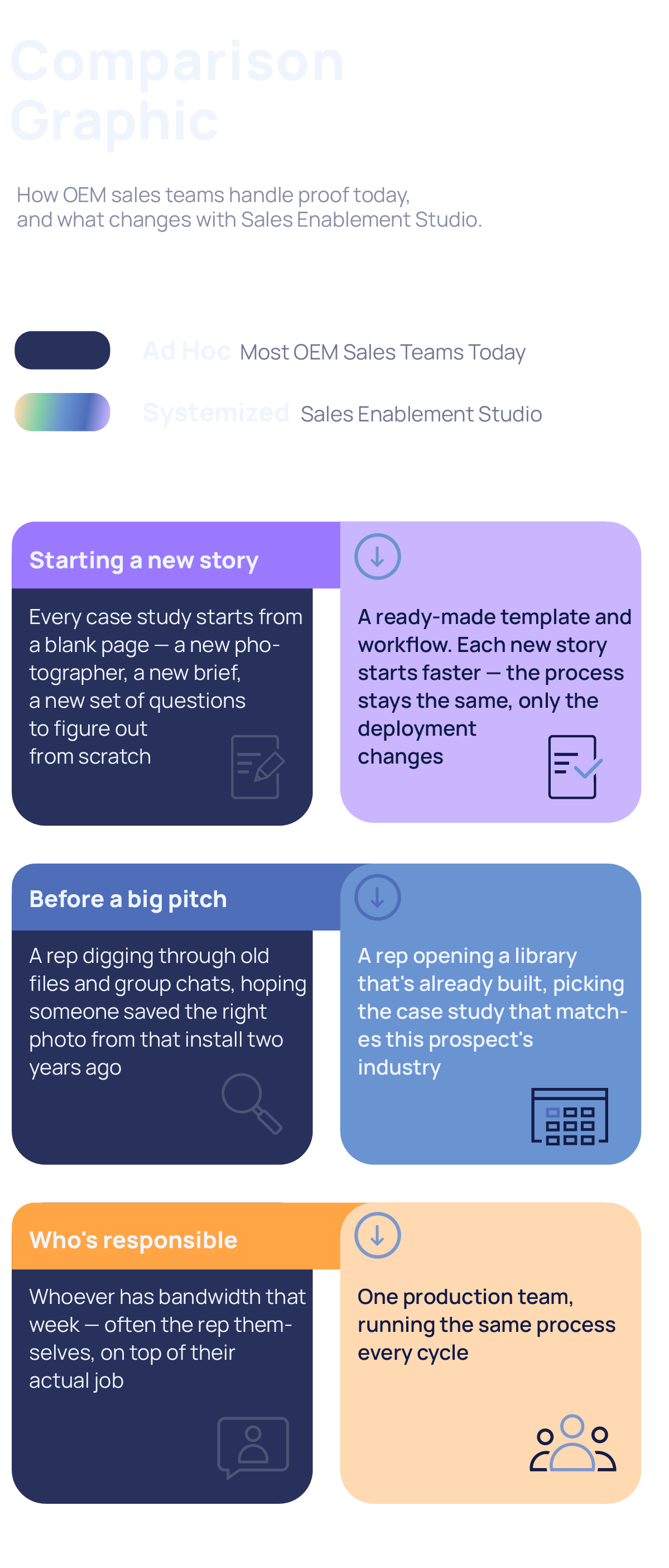
Retail-tech hardware manufacturers sell into long, consultative deals — a new store rollout, a new hardware standard across a chain — where the buyer's biggest question isn't "does it work," it's "has it worked, somewhere real, recently." Most mid-market retail-tech OEMs have exactly one or two case studies, both aging, because producing a new one has always meant briefing a photographer, chasing internal sign-off, and starting from zero each time. Meanwhile the sales team is trying to close deals with proof that's two product cycles old.
What Sales Enablement Studio gets you

A new case study for every meaningful deployment, not just the flagship one you already have — built from the account team's own account of what was installed and what changed.

On-site and studio photography of the hardware in its real deployment context, shot to one consistent visual standard across every asset.

A growing proof library instead of a one-off batch. New gear ships, new proof ships with it.
The sales materials built around that proof: battlecards and one-pagers your dealers and reps can actually hand a buyer, pulled from the same production line.

The full toolkit
The above are the items most retail-tech manufacturers lean on first. The full menu Sales Enablement Studio can produce for you:
-
A new store deployment or rollout turned into proof, every cycle.
-
Short video cuts for sales decks and RFP responses.
-
Spec- and integration-forward content for a procurement team's technical evaluation.
-
Re-cut for regional systems-integrator and reseller partners.
-
On-site deployment photography plus studio hardware shots.
-
For hardware still in development or hard to photograph once installed.
-
Arm reps for procurement-committee comparisons against named competitors.
-
Spec sheets and RFP-ready one-pagers.
-
Built around a specific chain's rollout or RFP.
-
A foundation for your own team's procurement pitches.
-
One story your sales and channel teams tell the same way.
-
Arm systems integrators and resellers to sell without you in the room.
-
Pre-built answers for the technical evaluation stage that slows procurement cycles down.
Not every engagement uses every item on this list — we start with what's slowing your procurement cycles down most and build from there.Investment
Sales Enablement Studio runs as a straightforward monthly subscription, not a one-time project — priced in the gap between doing nothing and enterprise agencies charging $15,000–$75,000/month for comparable case-study, video, and photography production.
Starter
€5,000
/month
Your first recurring case-study and content cycle.
Growth
€10,000
/month
A steadier cadence across case studies, video, and photography.
Custom
Scoped after a conversation
Higher-volume programs, multiple product lines, or a dedicated cadence.
All three tiers draw from the same toolkit above — the tier decides how much of it runs each cycle and how often.
The exact mix is confirmed when we scope your subscription.
How it works
01 – We interview
A short intake call with your account or engineering lead on a specific deployment: what was installed, what problem it solved, what changed for the retailer.
02 – We build
We handle production end to end — narrative, photography, video — coordinated on-site where possible.
03 – You received
You get a finished, on-brand case study delivered on a fixed turnaround, and the next one starts as soon as the next deployment is ready to tell.
Why Break the Grid, not the alternatives
This is the one vertical where "why us" isn't a hypothetical. We're not pitching a new capability — we're offering the same production system already running for Solum, adapted to a different retail-tech manufacturer's deployments. An enterprise agency can build something comparable, at a scale and retainer built for a company with an internal marketing function to manage it. This runs as a defined, recurring line instead, sized for a retail-tech OEM that wants the proof without the internal hire.
Common questions (FAQ)
-
The same system — the same intake process, production standard, and turnaround structure, applied to your deployments instead of theirs. We're not building this vertical from scratch.
-
Not without their sign-off, and we won't invent any. What we can show is the structure and quality of the finished case-study format itself, and talk through what applying it to your own deployments would produce.
-
Yes — in this category, proof that the product worked in a comparable deployment is usually the single most-requested asset from a buyer's technical evaluation team, more than a spec sheet or a demo alone.
-
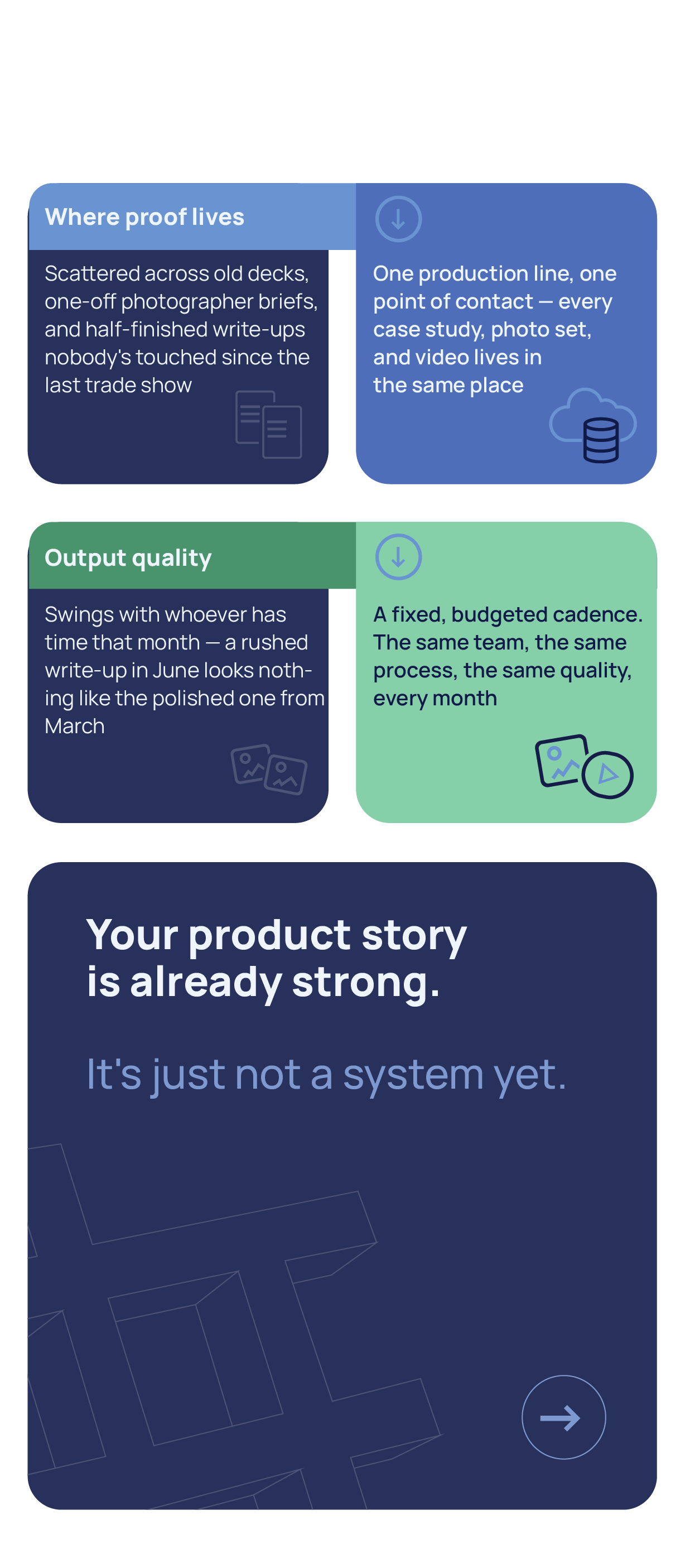
A one-off ages out the moment the next product cycle ships. This is a running production line — a new deployment becomes a new case study on a fixed schedule, so the library keeps growing instead of relying on the same one or two references for years.
-
Pick what your sales and channel teams actually use. Most retail-tech manufacturers start with case studies and deployment photography, and add battlecards or a partner enablement kit for their reseller network once those are working.
-
Three tiers: Starter at €5,000/month, Growth at €10,000/month, and Custom, scoped after a conversation for higher-volume programs — see the Investment section above for what each is built for.